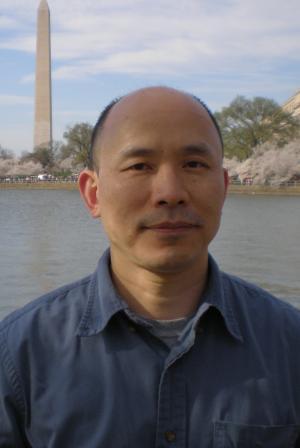
Dr. Wang works in the areas of Geometry and Topology, which are mathematical ways of studying the shapes of spaces. Funded by NSF and university grants, his research has been published in top mathematical journals. He has been invited to give talks at numerous universities, international conferences, and mathematical research centers. Dr. Wang has enjoyed his 20+ years of teaching experience, which includes teaching all levels of undergraduate mathematics and many different topic courses for graduate students. From 2013-16, Dr. Wang was on a leave from MU and served as a Program Director at the National Science Foundation. He worked in the Topology and Geometric Analysis programs within the Division of Mathematical Sciences.
Education
1990 Ph.D., Oxford University, United Kingdom
Frequently Taught Courses
Math 2320, Discrete Mathematics Structures
Math 4100, Differential Equations
Math 8250, Basic Topology & Geometry
Math 8502, Topics in Geometry
Math 8587, Topology Seminar
Math 8650, Differentiable manifolds and Riemannian geometry
Research Interests
Dr. Wang’s research focus is on various gauge theoretic invariants of differentiable manifolds; some of the main examples are Donaldson and Seiberg-Witten invariants as well as Floer homology. He was one of the first researchers to investigate Donaldson theory for singular connections which played a fundamental role throughout the development of gauge theory. Using the so-called real structures, he constructed a class of 4-dimensional manifolds that are neither decomposable nor symplectic (with the smallest non-trivial fundamental group). Dr. Wang’s has also strong interests in real algebraic geometry, foliations, and symplectic geometry.
MathSciNet Links
authored by Shuguang Wang
reviewed by Shuguang Wang
Select Publications
Wang, Shuguang: A Higher Dimensional Foliated Donaldson Theory, I, Asian Journal of Mathematics, 19 (2015), no.3, 527-554.
Wang, Shuguang: Objective B-fields and a Hitchin-Kobayahsi correspondence, Transactions of the American Mathematical Society, 364 (2012) 2087-2107.
Saveliev, Nikolai and Wang, Shuguang: On real moduli spaces of holomorphic bundles over M-curves, Topology & Its Applications, 158 (2011) 344-351.
Tian, Gang and Wang, Shuguang: Orientability and real Seiberg-Witten invariants, International Journal of Mathematics, 20 (2009) 573-604.
Li, Weiping and Wang, Shuguang: Instantons on conic 4-manifolds, the Fredholm theory, Journal of the Korean Mathematical Society, 44 (2007) 475-496.
Ruan, Yongbin and Wang, Shuguang: Seiberg-Witten invariants and double covers of 4-manifolds, Communications in Analysis & Geometry, 8 (2000) 477-515.
Wang, Shuguang: A vanishing theorem for Seiberg-Witten invariants, Mathematical Research Letters, 2 (1995) 305-311.